
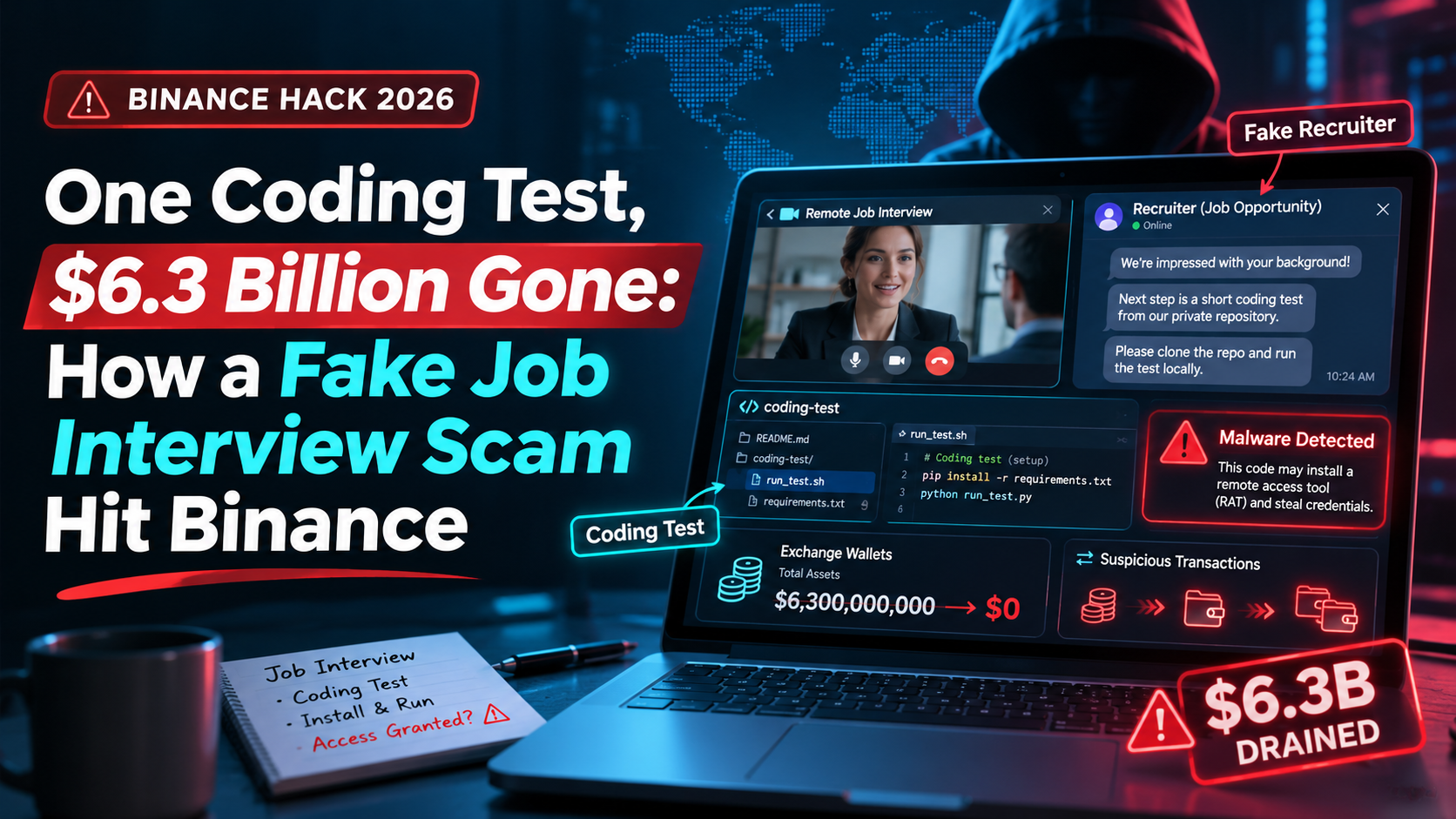
 One Coding Test, $6.3 Billion Gone
Picture this. Rohan, a backend developer in Pune, gets a LinkedIn message about a remote crypto role paying ₹38 LPA. Two friendly video calls later, he's asked to clone a repo and fix a bug by tomorrow.
That's close to how a fake job interview scam played out at Binance in September 2026. Weeks later, hackers used that foothold to take about $6.3 billion from the exchange.
This guide is for developers, freshers and IT staff job hunting in India. You'll see how the attack worked and how to tell a real recruiter from a fake one before you run anything.
In September 2026, a Binance engineer who was job hunting ran a "coding test" from a fake recruiter. It planted malware that helped North Korean hackers steal about $6.3 billion in October. The safest habit is to never run a stranger's code on your work laptop.
What happened in the Binance hack 2026?
The Binance hack 2026 is the largest crypto theft on record, well ahead of the $1.5 billion Bybit heist in 2025. On 29 October 2026, attackers drained about $6.3 billion from Binance's hot wallets.
A hot wallet is an online wallet an exchange keeps ready for everyday withdrawals. That convenience also makes it the easiest target.
Binance's own report puts the loss at about $6.34 billion. On 3 November, Binance said the attack started months earlier, with software hidden in an ad and a fake job interview scam aimed at its engineers.
| Date (2026) | What happened | Amount |
| 29 October | Binance hot wallets drained | About $6.3 billion |
| 31 October | Binance says it will cover the losses itself and has replaced 98% of affected token assets | Paid by Binance, not users |
| 3 November | Binance explains how the breach began | About $2.85 billion frozen or intercepted |
Who was behind it?
On 31 October, the FBI blamed TraderTraitor, a North Korean state-sponsored hacking group, confirming earlier findings by TRM Labs and Chainalysis. TraderTraitor is a sub-unit of North Korea's wider Lazarus Group.
The FBI says the same actors were behind the $1.5 billion Bybit hack in 2025. North Korea rejects the claim. Binance says it spotted 57 suspected North Korea-linked threats in 2026.
A social engineering attack tricks a person, not a computer, into opening the door. In the Binance case the cover story was a job offer, a tactic called pre-texting.
How the fake job interview scam worked, step by step
- June: A Binance wallet developer downloaded a tampered tool from a search ad. Binance replaced the laptop, but the team stayed exposed.
- September: A job-hunting engineer was approached on a real job platform. A fake HR rep ran a live video interview, backed by a social profile with personal photos.
- The test: A fake CEO then asked the engineer to download a code repository onto a work computer. It hid malware that got past the laptop's security tools.
- 20 October: Attackers used that laptop and an internal AI tool to take over two wallet developers' systems.
- 29 October: A script moved 233.46 million XRP from five hot wallets in four minutes. Withdrawals ran for nearly four hours.
The fake coding test malware worked because it looked like normal interview homework.
Job scam red flags: real recruiter vs fake recruiter
The biggest job scam red flag is being asked to run code or install software before you have an offer. Most fake recruiters also rush you and offer pay well above the market rate.
| Signal | Real recruiter | Fake recruiter |
| First contact | Company email or an established LinkedIn profile | New profile, few connections, quickly moves to WhatsApp or Telegram |
| Company check | Role is listed on the official careers page | Role isn't listed; website is new or thin |
| Interviewers | Names you can verify online | "HR" or "CEO" you can't find elsewhere |
| Coding test | Browser platform or a build-from-scratch task | A repo or zip to run locally |
| Timeline | Days to finish | "Run it before our next call" |
| Pay | Fits your experience | Far above market |
| Requests | Nothing before an offer letter | Install tools, share Aadhaar/PAN, pay a fee |
How do you spot a fake recruiter on LinkedIn? Check the profile's history and mutual connections. Then call the company on the number from its official website and ask whether the role and the recruiter are real.
Indian companies can also be looked up on the MCA company master data search.
Online job scam in India: why you're a target too
Fake job offers reach Indian job seekers too. In a July 2026 Indeed survey, 93% of Indian job seekers had seen suspicious offers, and 51% weren't confident they could spot a scammer.
In May 2026, the Home Ministry's cyber wing warned job seekers about fake online interviews. If you're job hunting on LinkedIn or Naukri, expect this kind of pitch to reach you.
If you're targeted:
- Call the 1930 helpline or file a complaint at cybercrime.gov.in.
- Save screenshots of the chats, emails and files you received.
- If you used a work laptop, tell your company's security team the same day. Companies in India must report cyber incidents to CERT-In within six hours of noticing them.
Skills to Stop Social Engineering Attacks (and How to Start a Career in Cyber Security)
Each stage of the Binance attack lines up with a skill security teams use every day.
| Attack stage | Skill that stops it |
| Fake recruiter makes contact | Spotting social engineering and checking people through public sources (OSINT) |
| Malicious coding test | Malware analysis skills: reading install scripts and opening files in a sandbox |
| Hijacked laptop | Endpoint monitoring and incident response |
| Wallets drained | Access control and quickly removing permissions |
The last row matters. Binance said its slow response in revoking access added to the losses.
Wondering how to start a career in cyber security? Learn networking and Linux basics first, then practise these skills in hands-on labs. An entry certification such as CompTIA Security+ or CEH can help you apply for SOC analyst roles, where you monitor alerts and respond to attacks.
At GICSEH, our cyber security course in Delhi covers these skills through lab work, taught by trainers.
The takeaway: treat every coding test as untrusted code
A real employer has almost no reason to ask you to run unknown code on your work laptop. If a take-home test comes as a repo to clone and run, open it in a virtual machine, or ask for a browser-based test. In the Binance case, one fake job interview scam was enough to open the door to $6.3 billion.
Want to be the person who spots these attacks before they land?
Learn hands-on defence skills with GICSEH's cyber security course in Delhi.
Book your free demo now.