
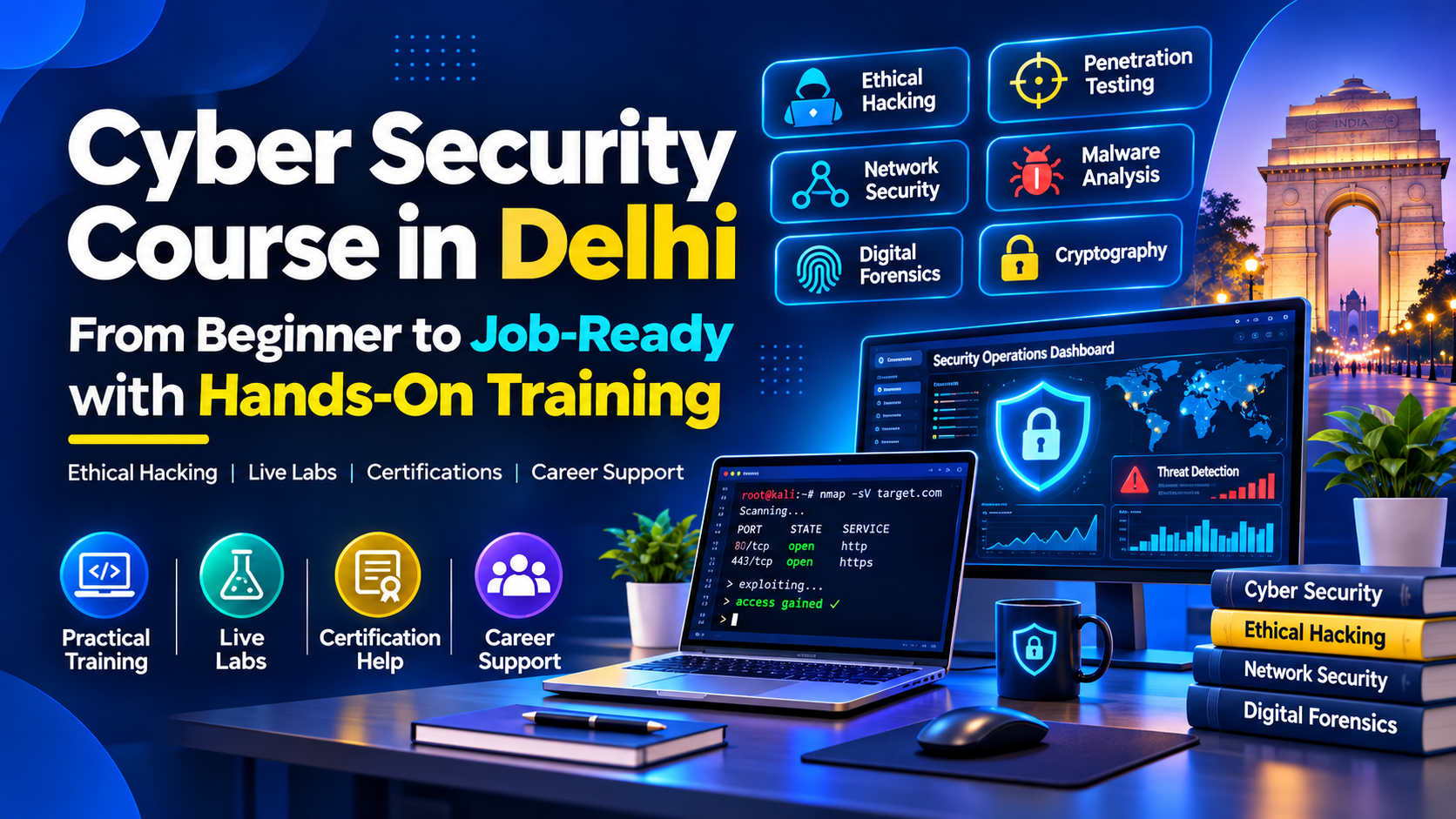
 Cyber Security Course in Delhi: Practical Training & Career Support
Ever got a call from a "bank officer" asking for your OTP? Maybe you hung up in time. Maybe someone you know didn't. Same trick, different day.
Behind every scam that gets stopped, there is a trained person at work. Many of them began with a cyber security course, right where you are sitting now.
Wondering if cyber security training is for you, even without coding skills? What does it cover, and where can it take you? Let's start with the basics.
What is a Cyber Security Course and Why Does It Matter Today?
A cyber security course enables you to prevent computers, apps, data, and computer networks from cyber attacks, online scams, or hackers. It will also prepare you on how to identify vulnerabilities.
It's been a busy day. UPI transactions, online shopping, train tickets, government portals - on the same phone. Cyber crime follows data wherever it travels, so banks and other companies need experts who can keep it secure.
Here is what you learn to protect:
- Data: Personal details, bank information and company records
- Networks: The Wi-Fi, servers and connections that link systems together
- Apps: Websites, mobile apps and payment platforms
- Devices: Laptops, phones and other connected gadgets
This is what security in information and digital safety is all about. This is what makes digital life possible on a daily basis.
Who Can Join? (Eligibility at a Glance)
Good news, you do not have to be a programmer to get started. Beginners will often start in the beginner stages and go from there.
| Profile | Can Join? | Starting Point |
| Student after 12th | Yes | Computer and networking basics |
| Graduate | Yes | Security concepts from the ground up |
| Working professional | Yes | Build on your current IT or job experience |
Not sure where you fit? Talk to our counsellors, and they will help you pick the right starting point.
What Will You Learn in Our Cybersecurity Course?
Wondering what a cybersecurity course actually covers? Here is the simple version. You start with how systems and networks work, then learn how attackers think, and finally how to stop them.
Everything is taught step by step, so even beginners can follow along.
| Module | What You Learn | Where It Is Used |
| Networking and security basics | How data moves and where it can leak | Every IT and security role |
| Ethical hacking | Thinking like a hacker, legally and safely | Finding weak spots before attackers do |
| Penetration testing and vulnerability assessment | Testing websites, apps and networks for gaps | Security audits and testing teams |
| Network security | Firewalls and safe network setups | Protecting company networks |
| Malware analysis | How harmful software works and spreads | Stopping viruses and ransomware |
| Digital forensics | Tracing what happened after an attack | Cyber crime investigation |
| Cryptography | How data is locked and kept private | Secure payments and messaging |
You also get to work with industry tools like Kali Linux, so it never feels like just theory.
Each topic connects to a real job task. So when you sit in an interview, you can say what you have actually done, not only what you have read.
How Does the Training Work? (Hands-On, Not Just Theory)
Training in cyber security will always be about more than just taking notes. The key to being able to call yourself a cyber security expert is to engage in practical learning. You are not just reading about an attack; you will also test it out in a laboratory environment yourself.
This way, you will have information that stays with you, and you will be able to respond to the question, “Have you ever done this?”
This is what the learning process looks like:
Live lab practice: Perform attacks and defense from the safety of clear setting where nothing can go wrong.
- Projects: Gain knowledge and skills that are measurable and applicable to job interviews.
- Mentor support: Trainers will help you if you experience difficulties.
- Open coaching sessions: Get questions answered at any time.
- Certification advice: Find out what certifications you should obtain.
Why GICSEH Is the Best Cyber Security Training Institute in Delhi
Deciding between what to study and where to study is equally difficult. Some students end up getting confused at this point due to the appealing offers made by every institute in Delhi NCR.
Don't just believe all the promises.
Do a few simple things before you buy any cyber security course.
| What to Check | Why It Matters | What You Get at GICSEH |
| Syllabus | Should cover basics to advanced topics | Step-by-step modules, from networking to ethical hacking |
| Labs and practice | Real skills come from doing | Hands-on lab sessions |
| Trainers | Good guidance makes learning easier | |
| Support | You should not feel stuck | Doubt sessions and mentor help |
| Certification help | Adds value to your resume | Guidance on industry certifications |
That is why many students look at GICSEH as the best cyber security training institute in Delhi. The focus stays on practical learning, not just notes and slides.
Here is what stands out:
Beginner-friendly start: no coding background needed
Practical approach: you learn by trying, not just reading
Clear guidance: counsellors help you choose the right path
Whether you want a first cybersecurity course or a skill upgrade for your current job, you can begin here.
Still unsure? Visit us, attend a demo class and decide for yourself.
Career Options After a Cyber Security Course
So, what happens after the course? Good question, and every student should ask it before joining.
The short answer: companies in almost every field need people who can protect their systems. Once you finish a cybersecurity course, you can explore roles like these:
Banks, IT companies, e-commerce platforms and government bodies all hire for these kinds of roles.
Your starting role will depend on your skills, practice and interview performance. That is why hands-on learning matters so much.
Certifications That Add Value to Your Cyber Security Course
A certificate alone won't get you a job, but it does make your resume stand out. It shows employers that your skills match an industry standard.
Your training helps you prepare for certifications like these:
| Job Role | What You Do |
| Ethical Hacker | Find weak spots in systems before real hackers do |
| Security Analyst | Monitor systems and spot suspicious activity |
| SOC Analyst | Work in a security operations team and respond to threats |
| Penetration Tester | Test websites, apps and networks for security gaps |
| Network Security Engineer | Keep company networks safe and running |
| Cyber Forensic Expert | Investigate what went wrong after an attack |
| IT Auditor | Check whether a company follows security rules |
- CEH (Certified Ethical Hacker): popular for ethical hacking roles
- CompTIA Security+: a good starting point for security basics
- CCNA Security: useful if you want to focus on networks
Not sure which one suits you? Our counsellors will guide you based on your goals, so you don't waste time or money on the wrong exam.
Ready to Start? Here Is How to Join
Joining a cyber security course doesn't need to feel complicated. Here is how simple it is:
- Enquire: call us or message us on WhatsApp with your questions.
- Attend a demo or counselling session: see how the classes work and talk to our team.
- Pick your batch: choose the timing that suits your schedule and begin.
Confused about which batch fits you? Talk to our counsellors. We will guide you honestly, whether you are a student, a graduate or a working professional.