
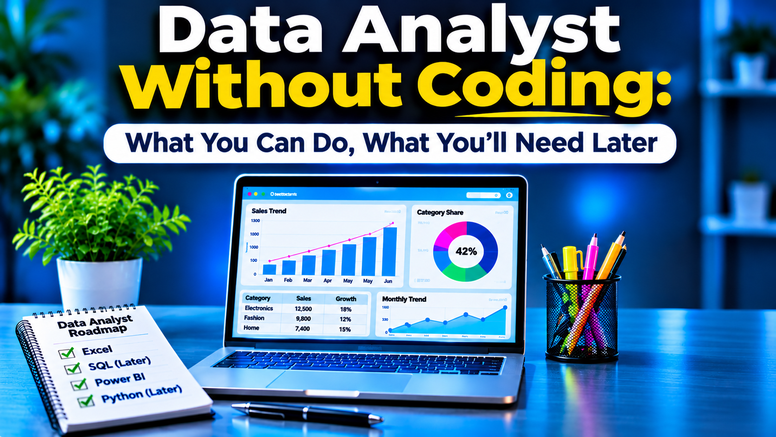
 Data Analyst Without Coding: What You Can Do, What You'll Need Later
You may have a B.You may have a B.Holding a degree in Com and working with the Excel reports throughout the day in Laxmi Nagar. You could come across the term “data analyst” on Naukri and find that all of the job postings call for coding skills such as SQL or Python. You may feel like you can't become a data analyst but that's not necessarily true.
The article is written for commerce, Arts and Non-IT graduates along with other people who are planning to change their jobs in Delhi NCR. It will outline the roles of a data analyst that do not involve coding, the roles that do require some knowledge of SQL and how to select an appropriate course if you are starting out from scratch.
So, is it possible to be a data analyst with no coding? Absolutely, it's possible. There are numerous entry level positions that involve reporting using Excel, Power BI and Tableau.
If you didn't know anything about the basic syntax of SQL, a skill you can pick up in as little as a month, you would have a higher probability of obtaining a job for some of those positions.
Can You Really Become a Data Analyst Without Coding?
Yes. You can start as a data analyst without coding. Many entry-level roles in India run on Excel, dashboards and business sense, not programming.
Job titles that often suit a non-coder:
- MIS executive: prepares daily and monthly MIS reports in Excel for sales or operations.
- Reporting analyst: updates recurring reports and checks the numbers for errors.
- Junior BI analyst: builds and maintains dashboards in Power BI or Tableau.
So is SQL coding? Only lightly. SQL (Structured Query Language) is a query language that pulls data from databases with plain-English commands like SELECT and WHERE. It feels closer to Excel formulas than to software code. Many beginners write useful queries within two weeks.
You can work as a data analyst without Python for a good while. Python helps once you want to automate reports, handle millions of rows or move into data science. Until then, learn SQL from scratch first.
Data Analyst Skills You Need (No Code Required)
The skills that get you hired fall into two groups: the tools you use, and the thinking behind them.
The no-code toolkit
- Microsoft Excel offers pivot tables, XLOOKUP, and Power Query which allows you to tidy up all your unstructured data in no time.
- Power BI, or Tableau transforms tables into dashboards used by managers on a daily basis. Power BI Desktop and Tableau Public can be downloaded for free. For assistance with practice training, our Power BI course has no prerequisites.
- Both Google Sheets and Looker Studio are free tools to learn hands-on.
- KNIME allows you to build data flows using a drag-and-drop interface without writing any code.
- Copy in Excel and Power BI allows you to write your formulas using plain English.
Skills that matter more than tools
- Business Questions – Start with the question ‘why did sales in Noida fall in October’ before any document is opened,
- Elementary Statistics – Averages, medians, percentage change, identification of outliers,
- Storytelling – Converting a graph into a specific course of action for the manager.
Employers rate this thinking highly. The World Economic Forum's Future of Jobs Report 2025 lists analytical thinking as the top core skill employers look for.
No-Code vs Low-Code vs Coding: Which Path Fits You?
Data analytics without coding is a real starting point, but it is one of three paths. Each path adds a skill on top of the last one.
| Path | Tools | Typical roles | Rough learning time (part-time) |
| No-code | Excel, Power BI, Tableau | MIS executive, reporting analyst | 2–3 months |
| Low-code | No-code tools + SQL | Data analyst, junior BI analyst | 4–5 months |
| Code | Low-code tools + Python | Senior analyst, data science track | 8–12 months |
The fresher data analysts salary in India ranges from ₹3 to ₹6 LPA (lakh per annum).
The overall average for data analysts comes in at a yearly ₹6,53,890.
For most career changers the low code option is the best time to time invested. Use no code tools at first, SQL in the third month, and Python once you get your first job.
The no-code approach becomes limiting for existing coders or individuals looking for machine learning opportunities. Go directly to SQL and Python.
A 5-Month Roadmap: Data Analytics for Beginners
This roadmap assumes 8–10 hours of study a week, which fits around a full-time job.
- Month 1: Excel. Master pivot tables, XLOOKUP and Power Query. Cleans up un-organized sales sheets with duplicated and empty cells.
- Month 2: Power BI / Tableau. Choose one software application and develop a dashboard using you worksheet.
- Month 3: Statistics and SQL. Understand averages and percentage changes, then basic SQL: SELECT, WHERE, GROUP BY, JOIN.
- Month 4: Establish a portfolio. Create three projects based on Indian data, for instance IPL cricket match or from an open data portal of Government of India.
- Month 5: start looking for a job. Revise your CV and LinkedIn profile, take practice interviews, and apply for 5-10 jobs each week.
A common mistake is skipping Month 4. Recruiters want to see finished projects, and a certificate on its own rarely gets you shortlisted.
How to Choose Data Analytics Courses in Delhi as a Non-Coder
What to check before you pay
- Syllabus sequence: It is ideal for Excel & Power BI to be taught before Python as any course opening with Python must likely be designed for those who already know programming.
- Live Projects: You must work on at least three live projects with feedback on your work.
- Batch timings: You must ensure the presence of weekend or evening batches if you are working full-time.
- Full fee: Confirm what is included in the fee (tools, mock interviews, placement support).
Fees vary widely. Data science and analytics courses in Delhi cost anywhere from about ₹3,000 for a short Delhi University certificate to ₹1,94,000 plus GST for an IIT Delhi executive programme.
Your First Step Doesn't Need Code
You can become a data analyst without coding. Excel and Power BI are enough to land MIS and reporting roles, and SQL is the one light technical skill worth adding by month three.
Often the hardest part is choosing where to start. Book your free demo now at GICSEH, and we'll look at your background and plan your first 30 days with you.