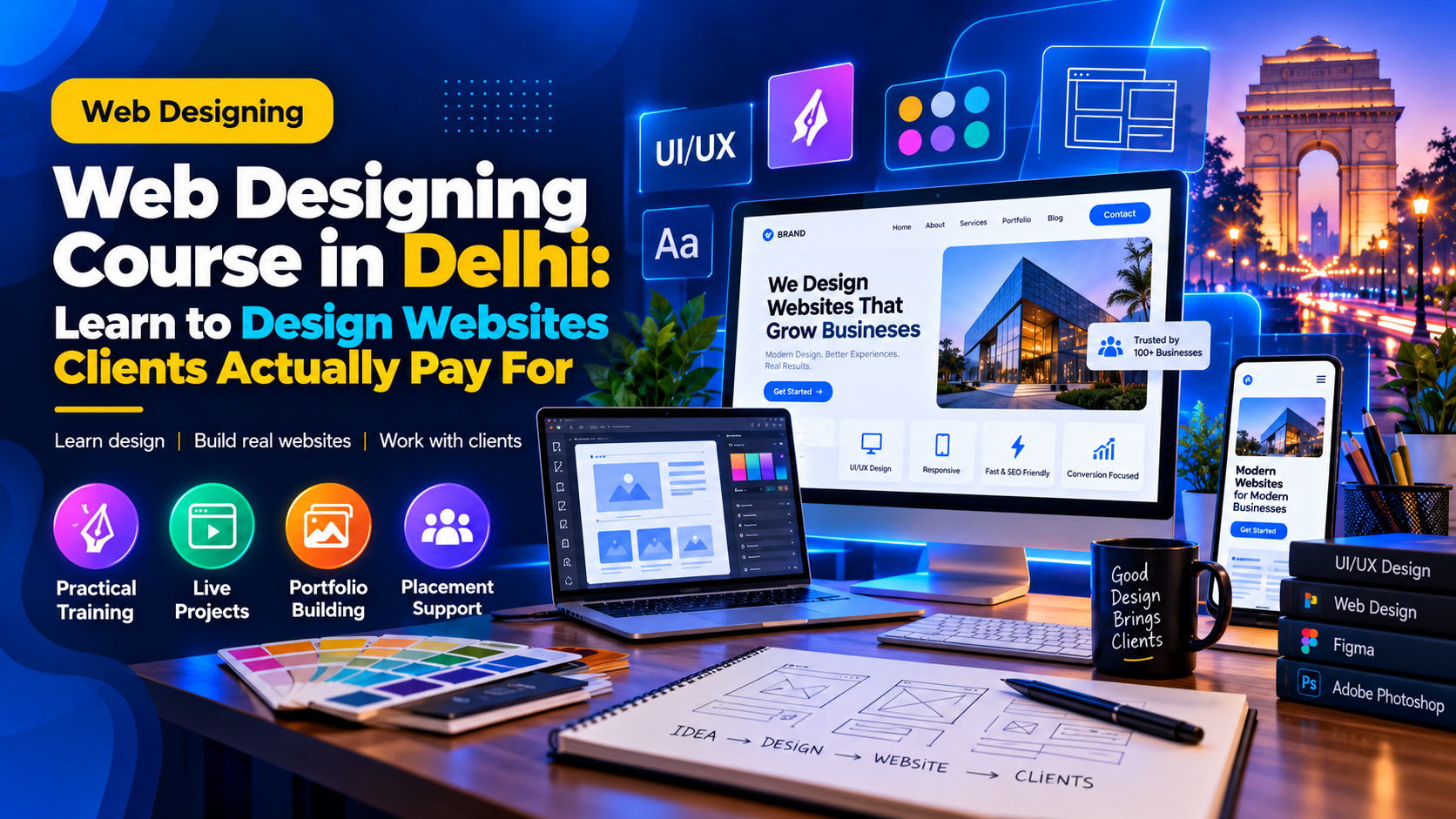
 Web Designing Course in Delhi
You land on a website and you know in seconds if you like it or not. No one explains to you why. Someone created that sensation and it wasn't by chance.
It's a person who is a web designer. Beginner web designing course is a place where an individual with no coding knowledge will learn that skill gradually starting from literally zero.
If you're a student, working professional, or a business owner who's tired of waiting on others, there's room for you in this industry.
Curious to see what it actually looks like? Here is a sneak peek of what is coming, from wireframes to Figma, and some surprises along the way.
What Does a Website Design Course Actually Teach You?
The website design course shows you how to build web pages including planning and design that are functional and attractive across devices and in providing the necessary information to visitors.
You need not worry if you are not acquainted with programming. The course considers beginners and starts from the very fundamentals.
Skills You'll Pick Up
- Layout, typography and colour theory: how to arrange a page and choose fonts and colours that suit a brand
- UI/UX basics: how people use a website and what makes it easy for them
- HTML, CSS and Bootstrap: the code that turns your design into a working page
- Figma and Photoshop: the tools for creating mockups and editing images
- Responsive design: making a site fit desktops, tablets and phones
- Basic SEO awareness: how page speed and structure affect search results
Is It Only About Making Pages Look Good?
It is not the case. Although looks are important, the design has to give directions to visitors. This is what is called visual hierarchy: the position, size and colour have the power to influence what people notice first.
You will also master the skill of wireframing, where a basic black and white outline is made before products are coloured and illustrated. This process will ensure lesser work at a later stage.
Web Design vs Web Development: Which Path Suits You?
Many beginners think these two are the same thing. They're related, but the work is different.
| Web Design | Web Design | |
| Focus | How the website looks and feels | How the website works |
| Work involves | Layout, colours, fonts, user experience | Coding, forms, databases, logins |
| Common tools | Figma, Photoshop | Programming languages |
Can You Do Both?
Yes, to an extent. Many designers learn HTML and CSS so they can build their own designs. That's why most web design institutes in Delhi now include some coding in the course.
Enjoy the visual side? Start with design. Prefer logic and problem-solving? Development may suit you better.
Who Should Join a Web Designing Course?
If you've ever thought, "I wish I could build my own website," this is for you. A website designing course doesn't need a particular background, only interest and regular practice.
- Students after 12th or graduation: a good way to start a creative, skill-based career
- Working professionals: useful if you want to move into digital work
- Print designers: you can take your design sense online
- Business owners: handy for managing your own website
- Freelancers: web design is a service you can offer to clients
Tools You'll Use in a Web Design Course (and Why They Matter)
A web designing course isn't just theory. You also get hands-on with the tools designers use every day.
| Tool | What it's used for |
| Figma | Designing screens, prototypes and working with a team online |
| Adobe XD | Mockups and prototypes, popular with Adobe users |
| Photoshop and Illustrator | Editing images and making graphics or icons |
| Browser DevTools | Checking spacing and how your design looks in a real browser |