
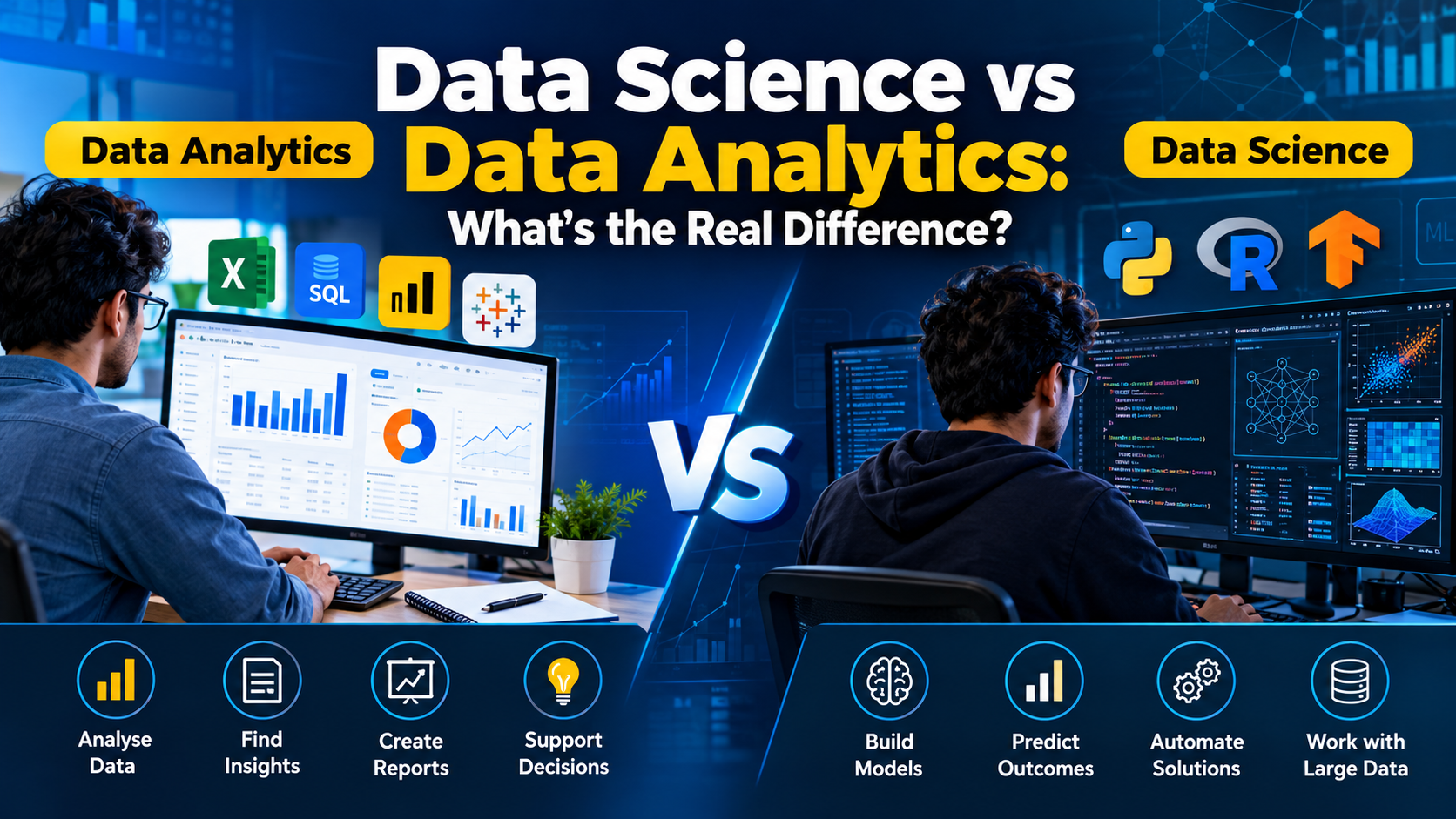
 Data Analytics vs Data Science
Data Science vs Data Analytics: Difference, Skills, Jobs & Career Path
If you've searched "data science vs data analytics" or asked "is data science and data analytics same," you've run into one of the most common points of confusion in the data field right now. These two terms get used almost interchangeably in job postings, course marketing, and casual conversation, and that overlap isn't accidental. But treating them as identical can push you toward the wrong course, the wrong skill investment, or a job search aimed at roles that don't actually fit what you're good at.
This guide breaks down the difference between data science and data analytics in plain terms, with real examples, a simple framework to make the distinction stick, and a clear answer on which path fits you better.
Is Data Science and Data Analytics the Same? The Short Answer
No, they're not the same, though they're closely related and often overlap in smaller organizations.
- Data analytics examines existing data to answer specific questions and support decisions happening now or that happened recently.
- Data science builds predictive models and systems, often using machine learning, to forecast what's likely to happen next or automate a decision at scale.
Put simply: a data analyst tells you what happened and why. A data scientist builds something that predicts what will happen or automates a response to it. Both work with data constantly, but the depth of modeling, programming demands, and daily work look meaningfully different.
A Simple Framework to Understand the Difference: The DIKW Pyramid
One useful way to think about where each field sits is the classic DIKW pyramid (Data → Information → Knowledge → Wisdom), a framework long used in information science to describe how raw data becomes actionable insight.
- Data: Raw numbers and facts (sales figures, website clicks, sensor readings)
- Information: Data organized into something meaningful ("sales dropped 12% in Q3")
- Knowledge: Understanding why it happened ("sales dropped because of a pricing change in a key region")
- Wisdom: Using that understanding to predict or act ("if we adjust pricing this way, we can prevent the same drop next quarter")
Data analytics work lives mostly in the "Information → Knowledge" zone. Analysts turn raw data into clear findings and explain the "why" behind them.
Data science work lives mostly in the "Knowledge → Wisdom" zone. Data scientists take that understanding further, building models that forecast outcomes or automate the response, rather than only explaining what already happened.
This framework is a genuinely useful mental model whenever you're trying to place a specific task, a dashboard, a report, a churn-prediction model, into one field or the other.
What a Data Analyst Actually Does: A Real Example
A data analyst's core job is to collect, clean, and interpret data to answer specific business questions, then communicate findings clearly to non-technical stakeholders.
Example: An e-commerce company notices a drop in weekend sales. A data analyst would:
- Pull sales data using SQL from the company's database
- Clean and organize it in Excel or a similar tool
- Identify the pattern (e.g., mobile checkout failures spiked on weekends)
- Build a Power BI or Tableau dashboard showing the trend clearly
- Present a recommendation to the marketing or product team
Core toolkit for data analytics:
- SQL for pulling data directly from databases
- Excel for quick analysis and reporting
- Power BI or Tableau for building dashboards stakeholders can actually read
- Growing use of Python for automating repetitive reporting tasks (though depth required is far less than in data science)
This is why searches for a data analyst course consistently rank among the highest-volume career-related searches right now, the barrier to entry is lower than data science, the timeline to job-readiness is shorter, and the skill applies across nearly every data-generating industry, which is to say, nearly every industry.
What a Data Scientist Actually Does: A Real Example
A data scientist's work sits further upstream and further into technical depth. Rather than mainly answering "what happened," a data scientist often builds the systems that predict what will happen.
Example: That same e-commerce company wants to reduce weekend cart abandonment before it happens, not just report on it after the fact. A data scientist would:
- Gather historical behavioral data across thousands of user sessions
- Build a machine learning model to predict which users are likely to abandon their cart
- Train, test, and tune that model using Python (with libraries like Scikit-learn or TensorFlow)
- Deploy the model so the website can trigger a real-time discount or reminder automatically
Core toolkit for data science:
- Python or R, used far more extensively than in analytics
- Statistical modeling and machine learning frameworks
- Comfort with large, messy, unstructured datasets
- Understanding of why a model works mathematically, not just how to run it
The path here demands more upfront time investment, but the ceiling tends to be higher too, both in problem complexity and typical compensation for genuine machine learning expertise.
Difference Between Data Science and Data Analytics: Side-by-Side Comparison
|
Data Analytics |
Data Science |
|
|
Main question answered |
What happened, and why? |
What will happen next? |
|
Core skills |
SQL, Excel, dashboards |
Python/R, statistics, ML |
|
Data type |
Mostly structured |
Structured and unstructured |
|
Output |
Reports, dashboards, insights |
Predictive models, algorithms |
|
Typical timeline to job-ready |
3–6 months |
6–12+ months |
|
Entry-level job volume |
Higher |
Lower |
|
Programming depth required |
Light to moderate |
Heavy |
Where the Two Fields Genuinely Overlap
Part of why "data science and analytics" get confused so often is that the overlap is real, not just marketing confusion:
- Both roles work with the same underlying data infrastructure and databases
- Both require strong SQL skills at some point
- Both depend heavily on clear communication, since neither role matters if findings can't be explained to non-technical people
- In smaller companies specifically, the two roles frequently blur into one person doing both, dashboard-building and predictive modeling, simply because there isn't headcount to separate them
This overlap is exactly why data analytics courses increasingly include an introduction to machine learning and predictive analytics as part of the broader curriculum, not because every analyst needs to become a data scientist, but because understanding where analytics work eventually leads makes you a more complete, more promotable analyst.
Data Analytics Courses vs. Data Analysis Courses: A Related Distinction
While untangling terminology, it's worth clearing up one more overlap. Data analytics courses tend to cover the broader discipline, including some exposure to predictive analytics and introductory machine learning, positioning you for growth toward analytics-heavy or even data science-adjacent roles later. Data analysis courses, by contrast, typically focus more narrowly on the core analytical skill set, cleaning, querying, visualizing, and interpreting data, exactly what most entry-level and mid-level data analyst roles actually require day to day.
Neither is objectively better:
- If you want to be job-ready as a data analyst quickly → a focused data analysis course covering SQL, Excel, and visualization tools gets you there efficiently
- If you're already eyeing a longer-term move toward data science → a broader data analytics course touching on statistical modeling and ML basics gives you a genuine head start
How to Decide Which Path Fits You
A few honest questions can help you choose before enrolling in either kind of program:
- Do you enjoy explaining findings to non-technical people, or building systems that operate on their own? Analysts spend real time presenting insights and fielding follow-up questions. Data scientists spend more time deep in code and mathematical reasoning.
- How much time can you realistically invest before needing to be job-ready? Becoming a competent, hireable data analyst typically takes three to six months of focused training. Genuine data science competency, beyond surface-level ML familiarity, typically takes six months to a year or more, depending on your starting math and programming background.
- How comfortable are you with statistics and programming right now? If writing Python code to build and tune a machine learning model sounds exciting, data science may fit naturally. If you're more drawn to spreadsheets, dashboards, and turning numbers into a clear business story, data analytics is the better starting point, and one you can always build on later.
- What does the local job market actually look like? Entry-level data analyst roles are consistently more numerous than entry-level data scientist roles, since fewer companies genuinely need predictive modeling at the entry level compared to how many need someone who can build a clean dashboard and answer a business question with data.
Why Starting With Data Analytics Is Often the Smarter Sequence
Even if data science is your eventual destination, there's a strong practical case for starting with data analytics rather than jumping straight into machine learning-heavy training:
- The SQL fluency, data-cleaning discipline, and business communication skills built in a data analytics course transfer directly into data science work later, they're not wasted effort
- The faster path to employment that data analytics offers means you can start earning and gaining real, resume-building experience with actual business data
- You can continue building toward more advanced machine learning skills on the side or in a follow-up program, informed by what you've actually learned you enjoy
This is exactly the sequencing GICSEH's own training reflects: our core program builds My SQL, Excel, Power BI, and Python fluency first, the genuine foundation of data analytics work, before introducing machine learning concepts as a natural extension rather than a separate, disconnected module bolted on at the end.
Making Your Decision With Confidence
The honest truth about "data science vs data analytics" is that it isn't really a competition between a better and worse option, it's a question of where you want to start and how quickly you want to be job-ready. Data analytics gets you into the field faster, with a genuinely strong, transferable foundation. Data science demands more upfront investment but opens the door to more advanced, often higher-paying, predictive and machine learning work.
If you're still unsure, starting with a strong data analytics course and paying attention to which parts of the work energize you most, the storytelling and business impact, or the modeling and mathematical problem-solving, is a reliable way to let your actual experience guide the decision, rather than trying to predict your preference before you've done either kind of work.
If you'd like to explore training built around exactly this on-ramp, our Data Analytics Courses page covers the full curriculum, and our Data Analytics Course in Delhi page has batch timings and certification details if you're based in the NCR region.